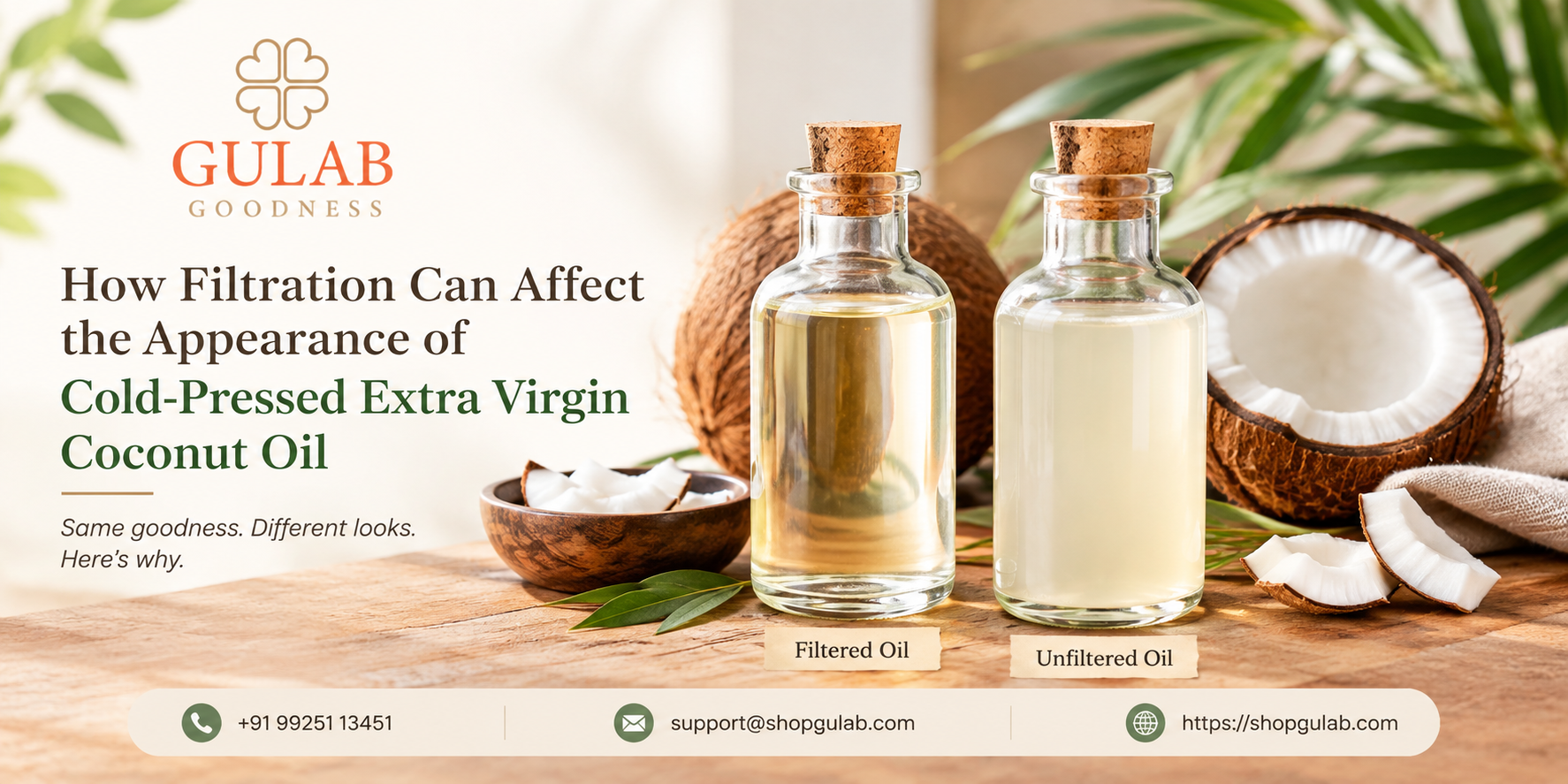
 When you pour coconut oil into a clear glass bottle, the first thing you may notice is its appearance. It can look beautifully clear, slightly hazy, or even contain tiny visible particles. For many people, this immediately raises a question: Does the appearance tell you anything about the quality of the oil?
The answer is not always straightforward.
Filtration is one of the processing steps that can influence how an oil looks without necessarily changing the fact that it was mechanically extracted. Codex guidance states that cold-pressed oils may be purified through processes such as settling, filtering, washing with water, or centrifuging.
So, if you are comparing cold-pressed extra virgin coconut oil ↗, understanding filtration can help you make a more informed choice rather than judging the bottle simply by how clear it looks.
What Happens During Filtration?
After coconut oil is mechanically extracted, it may contain very small suspended particles or traces of material from the coconut processing stage. Filtration is used to remove some of these unwanted particles.
The exact appearance after filtration depends on several factors, including the extraction method, the condition of the raw material, and the type and level of filtration used.
A technical publication from the ICAR-Central Plantation Crops Research Institute describes filtration of virgin coconut oil as a step used to remove fine particles that may remain after initial separation.
This means filtration is not necessarily about making an oil look “better”. It is primarily about removing material that should not remain suspended in the finished product.
Why Does Filtered Coconut Oil Look Clearer?
Think of filtration like passing freshly brewed tea through a fine strainer. The liquid remains tea, but small particles are removed.
The same basic visual principle applies to coconut oil.
A more thoroughly filtered cold-pressed extra virgin coconut oil may appear:
-
Clearer when viewed through a transparent bottle
-
More uniform in appearance
-
Free from obvious suspended particles
-
Cleaner-looking after settling
However, clarity alone should not be treated as proof of superior quality.
A very clear bottle does not automatically mean that the oil is better than another oil with a slight natural haze.
Is Slight Cloudiness a Sign of Poor Filtration?
Not necessarily.
Coconut oil can naturally change in appearance depending on temperature. It may become liquid in warmer conditions and turn cloudy or semi-solid as the temperature falls.
Therefore, it is important to distinguish between temperature-related changes and suspended particles.
If an oil looks different on a cool morning compared with a warm afternoon, that does not automatically indicate a processing problem.
Likewise, a slight haze should not immediately lead you to conclude that the oil is inferior. Appearance should be considered alongside other quality indicators.
Does Filtration Remove Everything?
No filtration system should be viewed as a magic step that removes every microscopic component.
The purpose is generally to reduce unwanted insoluble material and produce an oil with a more consistent appearance.
Codex quality guidance for cold-pressed and virgin oils includes a specification for insoluble impurities, illustrating why controlling such material is relevant to oil quality.
This is an important distinction: filtration can improve physical cleanliness without turning a traditionally produced oil into a highly refined oil.
Filtration Does Not Automatically Mean Refining
This is one of the most common points of confusion.
When people hear “filtered”, they sometimes assume the oil has undergone extensive refining. That is not necessarily the case.
Codex defines cold-pressed oils as oils obtained through mechanical procedures without the application of heat and permits purification through methods including filtering and centrifuging.
So, a filtered cold-pressed virgin coconut oil can still belong to the cold-pressed category when its overall production method meets the relevant definition.
The key is to understand the complete processing method rather than judging a product from one word on the label.
Why Can Two Oils Look Different?
Imagine placing two bottles of coconut oil beside each other.
One looks almost crystal clear. The other has a very faint haze.
That difference could result from several factors:
1. Filtration level
A finer or more thorough filtration process can remove more visible particles, resulting in a clearer appearance.
2. Settling time
Allowing an oil to settle can naturally separate heavier particles before final filtration or bottling.
3. Raw coconut material
The condition and preparation of the coconut can influence the amount of material that enters the extracted oil.
4. Temperature
Coconut oil is particularly sensitive to temperature changes. Its physical appearance can shift considerably as it cools or warms.
5. Processing method
Different mechanical extraction and separation methods can produce oils with slightly different visual characteristics.
This is why comparing oils solely by transparency can be misleading.
Should You Always Choose the Clearest Oil?
Not necessarily.
If your goal is to find the best cold-pressed virgin coconut oil, look beyond appearance.
Check whether the product provides useful information about its source, extraction method, ingredients, batch information, packaging, and storage recommendations. A trustworthy producer should be able to explain how the oil is made rather than relying only on attractive claims.
For food products, transparency matters because consumers deserve to know what they are purchasing.
You can also look for basic quality information supported by recognised standards. For example, the Bureau of Indian Standards currently lists testing under IS 542:2018 for coconut oil, including parameters such as moisture, insoluble impurities, colour, refractive index and specific gravity.
What Should Natural Cold-Pressed Coconut Oil Look Like?
There is no single appearance that proves an oil is authentic.
Depending on temperature and processing, coconut oil may be clear when liquid or appear cloudy and solid when cooler.
Instead of asking, “Is this oil clear?”, ask better questions:
-
How was the coconut processed?
-
Was the oil mechanically extracted?
-
Was filtration used?
-
Does the label clearly explain the product?
-
Is the ingredient list straightforward?
-
Is there useful batch or manufacturing information?
-
Does the oil have a clean, characteristic aroma rather than a rancid or foreign smell?
These questions provide much more useful information than appearance alone.
How Filtration Fits Into the Bigger Quality Picture
Filtration is only one part of producing good coconut oil.
Raw material quality, hygiene, extraction, moisture management, separation, filtration, storage, and packaging can all influence the finished product.
That is why cold-pressed extra virgin coconut oil should be evaluated as a complete product rather than based on one visual characteristic.
A clear appearance can be desirable from a presentation standpoint, but clarity should not be confused with proof of purity, freshness, or nutritional superiority.
A Practical Way to Evaluate Your Coconut Oil
The next time you buy coconut oil, take a minute to examine it properly.
First, check the label and understand what type of oil you are buying. Then look at the colour and clarity under normal room-temperature conditions. Smell the oil for its characteristic coconut aroma and check whether anything seems unusual.
Finally, consider the manufacturer's information about sourcing and processing.
This approach is much more reliable than choosing a bottle simply because it looks the clearest on the shelf.
Conclusion
Filtration can noticeably affect the appearance of cold-pressed extra virgin coconut oil by removing fine suspended particles and making the finished oil look cleaner and more uniform.
However, clearer does not automatically mean better, and slight cloudiness does not automatically mean poor quality. Temperature, raw materials, settling, and extraction methods can all influence how coconut oil looks.
If you are looking for cold-pressed virgin coconut oil, focus on the entire production story—mechanical extraction, filtration, quality controls, labelling, and transparency—rather than judging the product by appearance alone.
For those who want to understand sourcing and processing details before choosing an oil, Gulab Goodness ↗ provides product information to help you make a more informed decision.
Contact us ↗ if you have questions about the extraction, filtration, or quality characteristics of our coconut oil products.
For additional technical information on coconut and coconut-oil processing, you can also explore resources published by the ICAR-Central Plantation Crops Research Institute ↗. (ICAR-Central Plantation Crops Institute ↗)